- Fedora and CentOS stand
- Packaging eBPF Programs in a Linux Distribution: Challenges & Solutions
- From Code to Distribution: Building a Complete Testing Pipeline
- CentOS MythBusters
- Distributing Rust in RPMs for fun (relatively speaking) and profit
- Forging Fedora Project’s Future With Forgejo
- State of the Arch: Fedora on RISC-V
FOSDEM is a free event for software developers to meet, share ideas and collaborate. Every year, thousands of developers of free and open source software from all over the world gather at the event in Brussels. CentOS participated in FOSDEM 2025 and helped to run the Distributions Devroom.
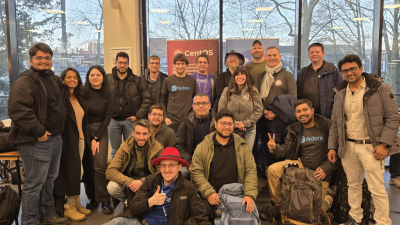
Fedora and CentOS stand
Find Fedora and CentOS contributors at the stand in the H building.
Packaging eBPF Programs in a Linux Distribution: Challenges & Solutions
Daniel Mellado • Mikel Olasagasti
eBPF introduces new challenges for Linux distributions: programs depend on kernel, CO-RE relocations, pinning behavior, and version-aligned bpftool or libbpf tooling. This session looks at what it really takes to package eBPF programs as RPMs and explores specific, real world usecases in Fedora. We’ll explore issues such as pinned maps, privilege models, reproducible builds, SELinux implications, kernel-user ABI considerations, and managing kernel updates without breaking packaged eBPF assets. The talk presents practical solutions, best practices, and tooling ideas to make eBPF a first-class citizen in mainstream distributions.
From Code to Distribution: Building a Complete Testing Pipeline
František Lachman • Cristian Le
How do you ensure code works across distributions before it reaches users? The Packaging and Testing Experience (PTE) project is an open-source approach to solving the upstream-to-downstream testing challenge.
The traditional model fragments testing: upstream tests their code, distribution maintainers test packages, and users discover the gaps. PTE bridges this by creating a continuous testing pipeline where upstream changes are automatically built, tested in realistic distribution environments, and validated before integration.
CentOS MythBusters
Carl George
CentOS is the Community Enterprise Operating System, a Linux distribution built by the CentOS Project. For over two decades, CentOS has powered servers and workstations around the world. During this time it has accumulated its fair share of myths, tall tales, and urban legends. Many of these stem from the transition from the legacy CentOS Linux variant to the modern CentOS Stream variant.
In this session, we won't just tell the myths, we'll put them to the test. In the spirit of the TV show MythBusters, we'll use observable data, historical events, and project insights to rate each myth as BUSTED, PLAUSIBLE, or CONFIRMED. Attendees will gain a better understanding of the advantages of CentOS and the state of the CentOS Project, which they can use to make informed choices for their own deployments.
Distributing Rust in RPMs for fun (relatively speaking) and profit
Fabio Valentini
This talk gives an overview of how Rust libraries ("crates") and applications are packaged as RPMs for Fedora Linux, and how this distribution mechanism addresses multiple shortcomings of the limited functionality of the distribution mechanism built-in to cargo, the Rust package manager:
- Application updates that are integrated with the system package manager.
- Automatic distribution of security updates independent of application releases.
- System integration features like shell completions, manual pages, launchers, etc.
- Test coverage for CPU architectures that are usually not available in CI systems.
Packaging Rust crates as individual RPM packages also simplifies package maintainer responsibilities, despite increased up-front work:
- Security issues in library code are patched once instead of once per affected package.
- Audits can happen once per crate / version instead of once per vendored copy.
- Test coverage for library crates (not possible when using vendored dependencies).
Forging Fedora Project’s Future With Forgejo
Tomáš Hrčka
Fedora Project is undergoing significant infrastructure changes that affect everyone from distribution users to individual contributors - that is migrating from Pagure to Forgejo as its primary Git forge for both source code and package sources. Our talk chronicles the journey from the early days of collective debating between GitLab and Forgejo with Fedora Council, through the ongoing migration of thousands of repositories with Fedora Infrastructure.
While the initiative began due to the need to move away from Pagure, it gradually evolved into one that also aimed at fixing the long-standing pain points faced with workflows. We got the opportunity to streamline the processes that made sense about a decade back and have since then, slowly started getting in the way of contribution. This also allowed us to contribute back to the Forgejo upstream with the features that would end up benefitting all.
Our findings serve as a blueprint for other distribution maintainers facing similar infrastructure decisions with maintaining their collaborative applications and services. They can take advantage of Fedora Project's learnings on building compatibility bridges, CI/CD workflow modernization, granular permission models, existing toolchain integration and comprehensive documentation - to ensure a sustainable approach to their significant infrastructure changes.
State of the Arch: Fedora on RISC-V
Kashyap Chamarthy • David Abdurachmanov
Efforts to port Fedora Linux to RISC-V began in 2016, long before physical hardware was accessible to developers. Today, the vast majority of Fedora packages have already been ported to riscv64 (i.e. the RV64GC baseline) and OS images—both generic and board-specific—are available for recent releases.
RISC-V is currently an alternative architecture in Fedora, so these (non-official) images are built by a dedicated team of community contributors, the Fedora RISC-V team. However, the end goal is to make RISC-V a primary architecture on Fedora.
So, what changed since the last update at DevConf 2024? What does the path for RISC-V to become a primary architecture on Fedora look like? What are we currently working on and what are our future plans?
Beyond software, we'll also survey the current hardware reality. Today several development boards are available. If one is getting started with RISC-V today, what board to pick? We'll review the available hardware, from the "VisionFive 2" to other capable boards, and outline our experience building Fedora on it.
Finally, whether you have a board on your desk or just a desire to contribute, there are many ways to help push Fedora’s RISC-V journey across the finish line. Join us to learn more!